
Lest music be made merely useful...
Investigating AI's grubby mitts all over music

There’s a circle of YouTube channels I stumbled upon yesterday. They have identical aesthetics. They are the output of DJs, named some flavor of “jungle / DnB” + various purpose clauses (”to code to,” “to vibe with”). Their thumbnail is grabby: A neon aesthetic early 2000s alt asian girl and a PlayStation logo strip on the left side.
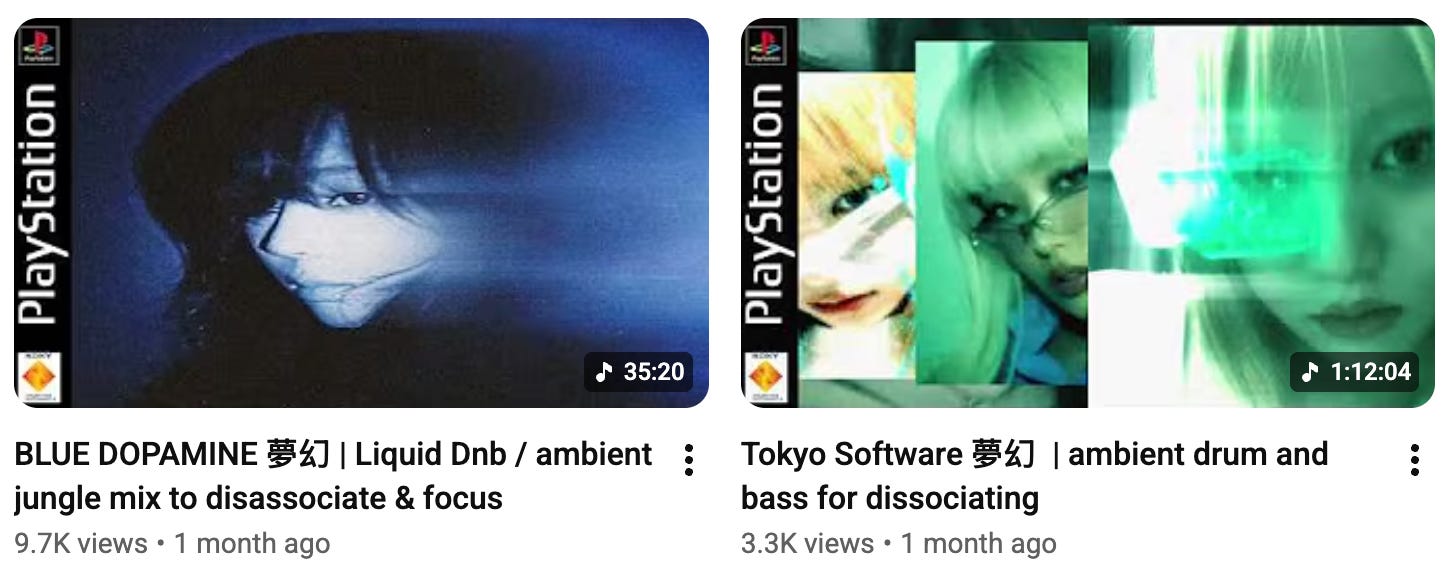
I was vibing with it. The mixes are of indistinguishable tracks that share amen breaks, a sin bass, and atmospheric pings with heavy delay. It’s the sort of music that’s all over those gritty night street racing games.
It’s all AI generated, of course. I was taken aback, a little disgusted with myself for having bumped to 15 minutes of the stuff without realizing. Shouldn’t have been all too surprising though: DnB is a sort of “five paragraph essay” genre. The conventions are extremely stable. The kick patterns are all identical, the skittering snare everywhere, phased-out pads like a three-pronged thesis.
Music AI seems somewhat undertheorized, even though it’s likely that we (the masses at large and not aspirational literary elites) will be exposed to a much greater extent. This must be due to the fact that students can shake the very foundations of education with LLMs that generate text and solve CS problems, while liquid DnB isn’t going to hurt things that we might consider more fundamental.
Music generation is radically different than language generation. Language is semantic, and thus LLMs hide their nature by becoming intelligible to our minds. The vast maths are obscured under the polished prose output that is (usually and increasingly) conceptually sound, even though the machine is not working with concepts as we understand it. Generated music, however, is somehow not obscured. Its output remains mathematical by being musical, in a way that is less alienated than the linguistic outputs of the chatbot.
Not everyone has a problem with this. The founder of one of the YouTube channels had this quaint exchange in the comments:
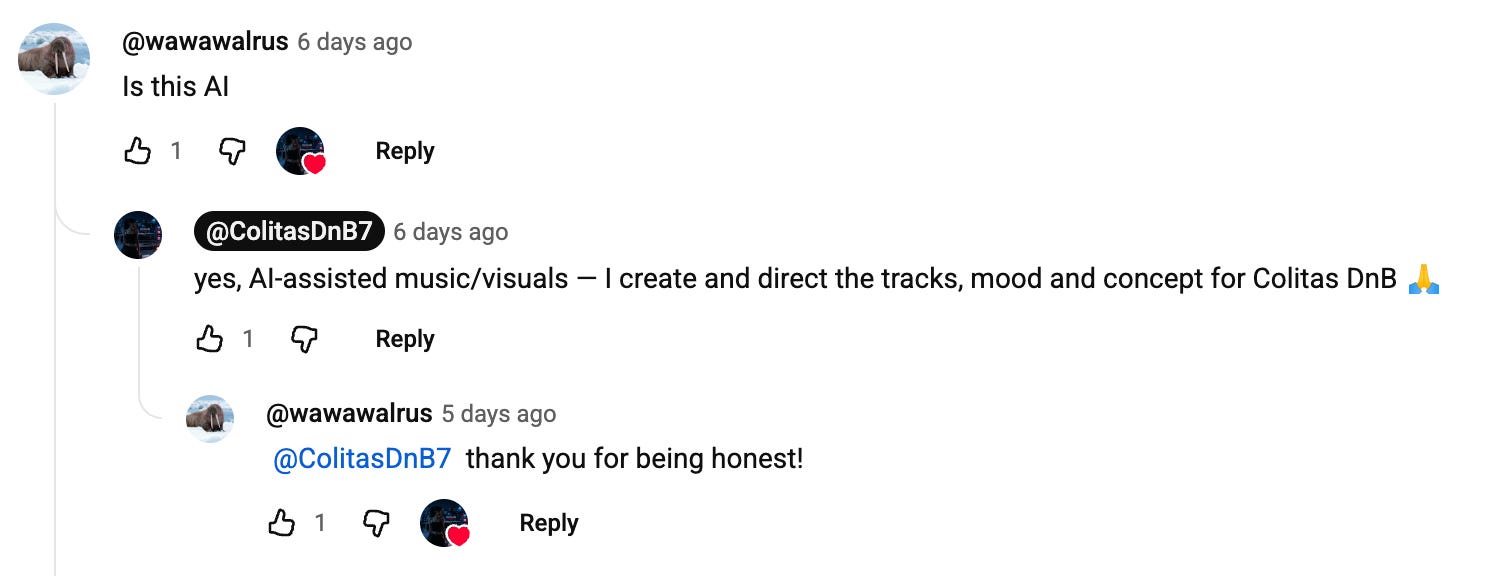
A “director,” eh? The snark buds easily: “You call typing ‘paradise city nostalgic liquid dnb / jungle mix’ directing, bud?” But, sure, that is an exciting thing that you can do now. You can love the particular conventions of the genre, and seemingly “create” your own without the difficult work of learning the highly technical skills that originally made it possible.
And it was originally highly technical. The late Mark Fisher loved jungle music, was there during its emergence, belting into a mic over frenetically sampled breaks that eventually cooled their way into incidental music for Skylight Racing 2088 for the PS1. It was a very cool resurrection of forgotten soul hits into something totally different. The song the drum samples come from sound nothing like the unfathomable number of DnB tracks that sprung from it. It was the old made new. Burial, another Fisher favorite, is the most skilled practitioner of this Poundian trade.
Isn’t that sort of what AI is doing? Rather than identifying coherent chunks of old records and splicing them, it is taking infinitesimally small samples and occultly categorizing them, to be summoned into the New on command. Wow! It’s not all that new, though, is one problem. The human element in Burial does not arrive by live performance of parts on instruments: It’s the sublime composition of disparate parts. It’s his recognizable library of samples (falling crystal tone from Dark Souls, reloading gun as a high hat, shaking spray can). For AI music, the human element can only arrive by the prompt and subsequent revisionary prompts. I cannot imagine a weirder, more incongruous way of making music than using words to prompt a machine. As I said before, music is not semantic. It doesn’t mean — it is. Using vague descriptions of “atmospheres” will reify clichés of genres like some gruesome spiral around the drain until music is just a collection of mood playlists. People will say “Hey Alexa, I want city skyline at night music.”
One way I’ve been interrogating my revulsion for AI music is to think of the threshold at which a tool will become disgusting. It seems that if the tool is sufficient in itself to create a finished product, then it disgusts me. A guitar pedal does nothing unless it receives signal. My MPKmini is silent unless I set up a virtual instrument. These tools, too, require some level of proficiency in a domain-specific skill. To homogenize the initial capital to a string of not-necessarily-precise language for all products seems disastrous.
Further, the tool itself turns music into something that it is not (though has been trending towards ever since muzak was first produced), which is a thing of utility. If music is a thing that can be generated according to your specific desire (i.e. “liquid DnB to study to”), it is accomplishing a bounded task. Music doesn’t solve problems. Music shouldn’t be made according to a spec sheet. Such things are not beautiful, as nothing produced according to a spec is going to be revelatory of the transcendent. True beauty is never the thing you merely think you desire. It’s never what you have in mind.
For some old made new that I’ve been enjoying recently, here’s a band that marshals all the aesthetics of the early 2000s into a comprehensive package. There’s enough in here, enough variety between their tracks (and enough shared sound!) to pin it as really new. There does not exist a prompt to produce such a thing (though I admit, I have not experimented with “frutiger aero visuals, photorealistic mirror’s edge half-urb office park, breathy female pop over flim-like sin waves and trip-hop drums”):