
Schools: a view from the encyclical
What we're working with in the traditional school system

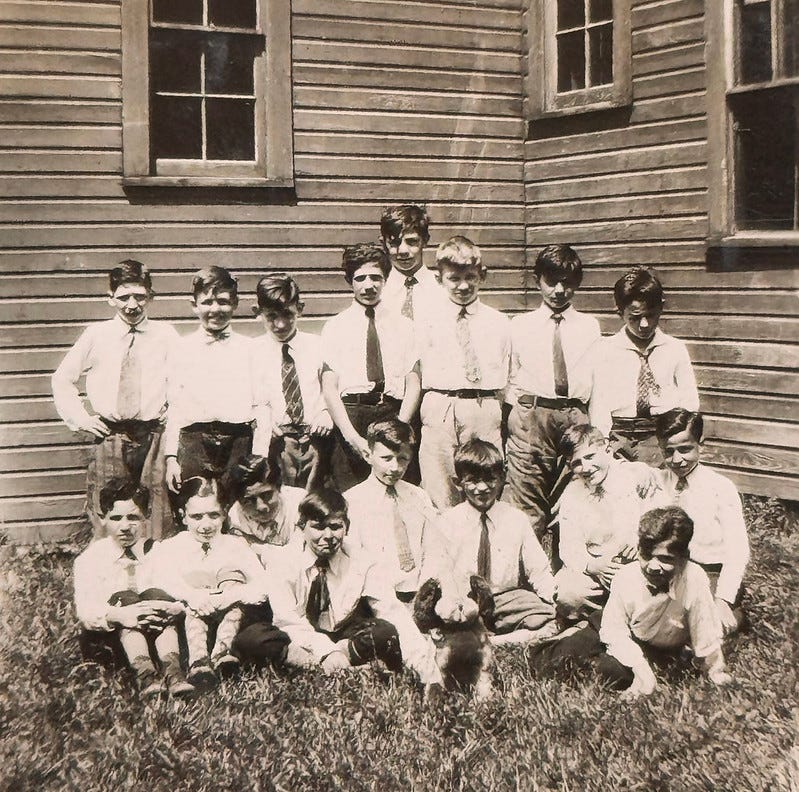
There are certain natural principles to which we act in opposition when we throw a bunch of age-stratified groups of coed youths into indoor spaces for half the days in a year. You remember from your own time in those rooms the ways your physiology, your own chaotically developing psyche, would react. Teachers experience the daily spectrum of rebellions emerging from this adolescent stew.
Nevertheless, it’s what we’ve got. The system is so established and so widespread, so adapted to the post-industrial schedule from which it emerged, that significant alteration of the thing’s structure is unlikely. There are alternatives, and in Magnifica humanitas, the right of parents to choose the mode of schooling is strongly affirmed.
These reflections will not dwell on those alternatives. Rather, I’m going to look at the brief five-paragraph section (§143–147) of the much longer encyclical that outlines certain problems plaguing education and suggests principles that apply to the standard school system where most parents send their children.
The striking intro to the section might get a laugh out of some of the jaded: “School is the place where new generations can learn to seek and love the truth, to reflect on the meaning of life and to recognize the dignity of every person.” School, then, is defined by its potential end, which is much loftier than job or college preparation. It can be a place of meditation, in which the truth is sought across disciplines, life itself becomes an object of reflection, and relationship is ordered toward the dignity of the other. The final paragraph of the section returns to the last prong of this thesis, stating that “schools are not called to follow the pace of the digital world, but to offer that which the digital sphere by itself cannot provide, namely a shared time for learning and developing trustworthy relationships.” The essentially relational aspect of school is emphasized and is the primary distinction between it and the “digital world.”
In another sense, the advent of AI, with its truly awesome ability to dispense information in a manner minutely tailored to the user, should eradicate any conception of school as a place of individual learners picking up knowledge and skills from individual teachers. That’s what Alpha Schools are doing. They’ve disintegrated the learning entirely from the real social component. Students get the academics out of the way in two hours so they can do “life skills” stuff afterwards, so the marketing goes. But this disintegration will not result in what school is for (love of truth, contemplation of the meaning of life, respect for the dignity of the other).
This model is, quite clearly and intentionally, following “the pace of the digital world.” What, then, is the alternative? How do we do what §145 demands: “The organization of schools, physical spaces, evaluation methods and the role of teachers themselves must be rethought in order to promote an authentically integral education that addresses every dimension of the person.”
I can’t address all four of those in this quick reflection. Maybe I’ll write a book after a few more decades of experience. But broadly speaking, we could perhaps epitomize those four categories as the culture of the school. We might say that school culture must be rethought, in such a way that everything in the school serves the end that all culture is to serve: “the integral perfection of the human person, to the good of the community and of the whole society.” (GS) In fact, if culture is “what most people do most of the time,” teachers have an enormous moral obligation in the traditional school system to be genuinely concerned with this integral perfection! If most students are in classrooms most of the time, the culture of those classrooms must be unified in end. Every teacher has to be concerned with the culture, which is not reducible to curricula, to the stuff that is tested. It’s the arrangement of desks. It’s the fact that there are desks, even, and that they are all identical. The size of the room, the type of lighting, the paintings on the wall. The teaching modalities employed. The ratio of teacher talk to student talk. It’s the presence the teacher gives the students, or the students give to each other.
One concrete modality that aligns entirely with the encyclical’s suggestions is the seminar. The seminar is a loving conversation involving every student, with the teacher serving as authoritative guide, oriented toward the discursive meditation of some true object. Seminars are impossible to simulate. They are real-time, and they require rigorous attention. There is no pause but at the teacher’s discretion. Thus, the students keep pace only with one another, prodded and nudged by the teacher.
What is the culture of a classroom that’s typical day is one of seminar? The classroom is a space where students spend most of their time facing each other. They grow less individualized, less hidden. The seminar itself, by being open toward all aspects of the truth, capable of being led down a near infinite approaches to that Simplicity, means there isn’t some assessment lying in wait in the always-potential future. The time spent in the class, in community, is itself the most important thing. The time spent actively in the presence of one another is what’s real.
Gaudium et spes continues: “Therefore it is necessary to develop the human faculties in such a way that there results a growth of the faculty of admiration, of intuition, of contemplation, of making personal judgment, of developing a religious, moral and social sense.” I would argue that this growth is precisely what occurs in a seminar. Mimetically, under the authority of a teacher who loves truth, all of those faculties will be learned. Learned by doing, importantly (which is the only way they can be).
Anyways, the seminar is a bit of a hobbyhorse for me. I tend to be overzealous and think of it like a silver bullet. The general point is that schools must integrate learning with the social dimension of the human person. The seminar happens to be the purest way to do that, without sacrificing moral and intellectual authority as is so often the case in small group work or the ever-amorphous project.
I’d recommend looking at Mortimer Adler’s classic The Paideia Proposal, particularly part one, on the three types of learning. Seminars stand at the beginning as the cultural bedrock of his proposition, with coaching next, and direct didactic instruction last.
The third challenge the encyclical notes “concerns knowledge.” It probably is worth quoting in full: “Without careful attention, an educational system lacking in a love for truth may emerge, in which an incessant flow of information replaces the essential exercise of research, reflection and discernment. As knowledge becomes increasingly fragmented, it becomes difficult to grasp reality as a whole, to ask profound questions about meaning, or to develop authentic, critical and creative thought. Many educators already report signs of dehumanization, where people may “know many things” but struggle to find direction in their lives, partly due to an inability to connect information with deeper knowledge or maintain a sense of purpose. A genuinely healthy attitude is needed, requiring rhythms that incorporate silence, in-depth study, reading and judicious analysis, for without these elements inner freedom may be compromised” (§146).
Under the individualistic, didactic model of schools, information is siloed between disciplines. Subjects are foreign countries. They have distinct cultures. No person can thrive as a cosmopolitan, shuttled between these worlds every hour. The variance in creation is illustrated as though in several incomprehensible, untransferable languages, rather than as contributing to an integrated understanding of reality. Richard Weaver’s Ideas Have Consequences (1948) described the loss of the “philosophic doctor” as an ideal, and its replacement with the “expert,” who has a robust specialized knowledge without reference to separate disciplines. The philosophic doctor (doctor, of course, meaning “teacher”) attempted to synthesize all knowledge. They sought a grand theory by which the world could be grasped insofar as the human mind is capable.
What I see happening in schools (particularly secondary schools, where I have mainly taught) is students receive in each subject specific knowledge and abilities, resulting in miniature expertise across fields. There is no institutional attempt to contemplate Calc II, Chemistry, Modern History, and World Literature as constituting a universe. Further, just by raw class hours, each core subject exists without hierarchy, which is deeply unnatural! Subjects that should not be hierarchically lesser are relegated to elective status (philosophy and fine arts).
The last bit contains some pedagogical suggestions, namely that classroom culture should incorporate “silence, in-depth study, reading and judicious analysis.” Of those, only the first seems specific enough to be meaningful. Allowing the conversation to resolve itself, for noise to fall away, provides the conditions for the inner life to bloom. That is “inner freedom” — the freedom from stimulus. Classroom culture must tend toward silent delight, a voluntary ‘chewing’ on the goods of the days work.